
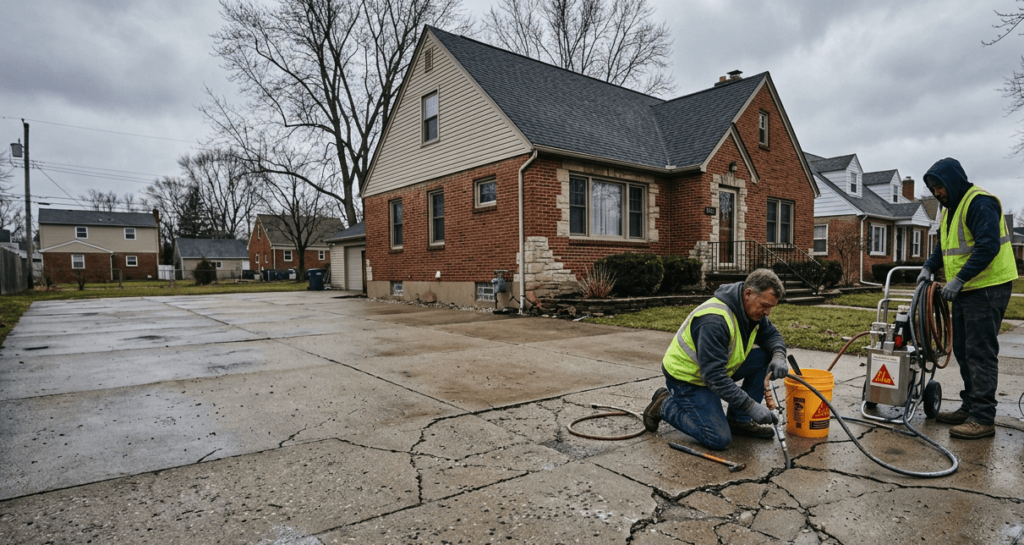
If you own property in Cleveland, concrete damage isn’t a matter of if, it’s when. Between brutal freeze-thaw winters, heavy road salt exposure, and the region’s clay-heavy soil, Cleveland puts more stress on concrete than almost anywhere else in Ohio. Whether it’s a cracked driveway, a crumbling foundation wall, or structural concrete that’s started to shift, understanding what’s actually happening beneath the surface is the first step to fixing it properly instead of pouring money into a patch job that fails again next winter.
Why Cleveland Concrete Takes So Much Damage
Cleveland’s climate is uniquely hard on concrete. Every winter, moisture works its way into small surface cracks, freezes, and expands, widening those cracks bit by bit. Add repeated freeze-thaw cycles over a full season, and small hairline cracks turn into structural problems within just a few years. Road salt makes it worse. Salt accelerates corrosion in any embedded rebar and speeds up surface deterioration (spalling), which is why so many Cleveland driveways, sidewalks, and garage floors show pitting and flaking that homeowners in warmer climates rarely deal with.
On top of the weather, Cleveland’s clay soil expands when saturated and contracts when dry, putting constant pressure on foundation walls and slabs. That’s the underlying reason homeowners searching cleveland foundation repair or cracked foundation repair cleveland are usually dealing with something more than a cosmetic crack. It’s soil movement pushing against concrete that was never built to flex.
Common Concrete Problems We See Across Cleveland
Driveway and sidewalk cracking. The most visible and most common issue. Anyone searching driveway crack repair near me or concrete crack repair near me is typically dealing with freeze-thaw cracking that’s progressed past the point where sealant alone will fix it.
Foundation wall cracking. Horizontal or stair-step cracks in a basement or foundation wall are a different animal entirely from surface cracking. These usually indicate soil pressure or settlement, and searches for foundation repair cleveland ohio or foundation repair cleveland oh are almost always tied to this kind of structural movement rather than a simple surface fix.
Spalling and surface deterioration. Flaking, pitting, or crumbling concrete surfaces are typically caused by a combination of freeze-thaw cycling and road salt exposure. Left untreated, spalling exposes the concrete’s internal aggregate and accelerates the damage.
Garage floor and slab cracking. Vehicle weight combined with temperature swings creates a slow, steady cracking pattern in garage slabs that’s easy to ignore until it becomes a tripping hazard or lets water into the space below.
Commercial and structural concrete restoration. Property managers and businesses searching concrete restoration services inc or concrete restoration services near me are often dealing with larger structural repairs: parking structures, loading docks, or building foundations that need more than a patch kit.
Concrete Repair vs. Concrete Restoration: What’s the Difference
These terms get used interchangeably, but they’re not quite the same thing.
Concrete repair addresses a specific, localized problem: a crack, a chip, a small area of spalling. It’s targeted and usually faster.
Concrete restoration is a broader process that addresses widespread deterioration across a larger surface or structure, often involving resurfacing, structural reinforcement, or full section replacement. This is what most callers searching expert concrete restoration and repair or concrete repair restoration contractors actually need once damage has spread beyond a single crack.
Knowing which one you need matters, because a quick patch on a foundation wall that’s actively shifting from soil pressure won’t hold. That situation needs a proper structural assessment, not just fresh concrete poured over the crack.
When a Concrete Crack Is Actually a Foundation Problem
Not every crack is urgent, but certain signs mean you’re looking at foundation movement rather than surface wear:
- Cracks wider than a hairline, especially if they’re growing
- Stair-step cracking in block or brick foundation walls
- Cracks that run horizontally rather than vertically
- Doors or windows sticking near the affected wall
- Visible bowing or leaning in a basement wall
- Water intrusion following the crack line
If you’re noticing any of these and searching cleveland foundation repair, get a professional assessment before assuming a DIY concrete patch will solve it. Patching over active settlement just delays a bigger repair, and usually makes it more expensive.
Why DIY Concrete Patching Often Fails in Cleveland
Big box store crack fillers are built for stable, mild climates. In a Cleveland winter, that same patch is going to face the identical freeze-thaw cycle that caused the original crack, and most consumer-grade fillers don’t have the flexibility or bonding strength to hold up. Professional concrete repair uses materials matched to the specific type of damage, proper surface prep, and correct curing conditions, which is the difference between a repair that lasts one season and one that lasts a decade.
How We Help Cleveland Property Owners
We handle the full range of concrete and foundation issues property owners across Cleveland deal with, including:
- Driveway, sidewalk, and slab crack repair
- Foundation wall crack repair and structural assessment
- Spalling and surface deterioration restoration
- Garage floor and basement floor repair
- Foundation stabilization for active settlement or shifting
- Commercial and structural concrete restoration for larger properties
Whether you’re dealing with a single cracked section of driveway or a foundation wall that’s showing signs of real structural movement, we can assess the actual cause before recommending a fix, so you’re not paying twice for the same problem.
Serving Cleveland and Surrounding Communities
We also serve University Heights, Bay Village, North Olmsted, Ohio City, and communities throughout the greater Cleveland area, all of which deal with the same freeze-thaw and clay soil conditions that drive concrete and foundation damage in this region.
Leave a Reply